Across the country, the most resonant HIV PrEP campaigns don’t come from distant boardrooms; they’re born in barbershops and beauty salons, on social media, in clinic waiting rooms, in corner stores, and in community feeds. When local leaders shape the message, it resonates. This article highlights why elevating local leadership is essential to the first stage of the PrEP continuum—AWARENESS—and invites you to share examples so we can learn, replicate, and scale what works.
Why Local Leaders Matter for Awareness
Awareness is the on-ramp to the PrEP continuum. If people don’t know about PrEP—or don’t see it as “for people like me”—they never get to interest, access, initiation, or persistence. Local leaders— peer navigators, barbers and stylists, youth organizers, harm-reduction champions, community clinicians, and neighborhood content creators—carry trusted relationships. They translate clinical facts into everyday language, connect PrEP to local realities, and lower the social temperature around sexual health.
What local leadership adds to awareness:
Cultural fluency: Messaging that fits local speech, humor, values, and imagery.
Credibility: Familiar faces reduce skepticism and stigma.
Context: Campaigns that reflect real barriers (transportation, hours, childcare, privacy) and real solutions.
Continuity: Leaders remain in the community after a campaign ends, sustaining conversation and trust.
What “Good Awareness” Looks Like
At the awareness stage, the outcome isn’t a prescription it’s recognition and curiosity:
People can name PrEP and identify who it’s for (including themselves).
They understand how PrEP prevents HIV and that options exist (oral and long-acting).
They know where to learn more or book—a link, a QR code, a phone number, a person.
Design Principles for Community-Led Awareness Campaigns
Co-create with residents. Put local leaders on the creative brief, not just in the photos. Pay them for strategy, not only “influence.”
Make the invisible visible. Show Black women, queer and trans folks, faith-active communities, and rural neighbors—people too often missing from PrEP imagery.
Lead with belonging, not blame. Use strengths-based language (“protect your joy,” “care you can carry”) instead of risk-only framing.
Short paths to action. Every visual should point clearly to “Learn more” or “Book now” with a local, low-friction option.
Channel fit. If the message lives in a sanctuary, a salon, or on Snapchat, shape it for that place.
Measure what matters. Track reach and recall (“Have you heard of PrEP?”), Message clarity and click-throughs to information/booking.
What’s Replicable—and What Must Stay Local
Replicable elements: templates, slogans, call-to-action flows, QR code landing pages, privacy language, mini-toolkits for barbers/faith leaders/peer ambassadors, and evaluation checklists.
Must stay local: faces, voice, place references, partner logos, event cadence, and community promises (e.g., “same-day starts,” “discreet pickup,” “no insurance needed”).
Call for Campaigns — Due November 1
I’m inviting colleagues, health departments, CBOs, clinics, faith partners, designers, and community creatives to submit links and websites to your HIV PrEP awareness campaigns. We will compile and share them on November 1—not as a competition, but as a community engagement effort to see:
What exists,
What’s replicable,
What’s scalable.
Submit your links and websites by November 1 to leishamckinleybeach@gmail.com On November 1, we’ll release the collective roundup, allowing communities everywhere to see what’s available, what’s replicable, and what can scale. Let’s learn from one another—and make awareness impossible to miss.
Example
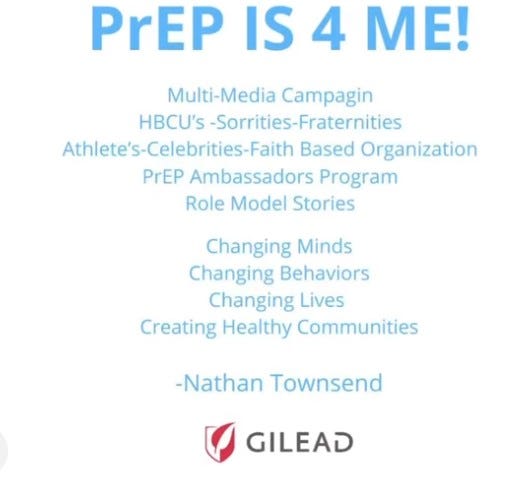
One of my top 2025 local campaigns is “PrEP Is 4 Me” by Nathan Townsend