
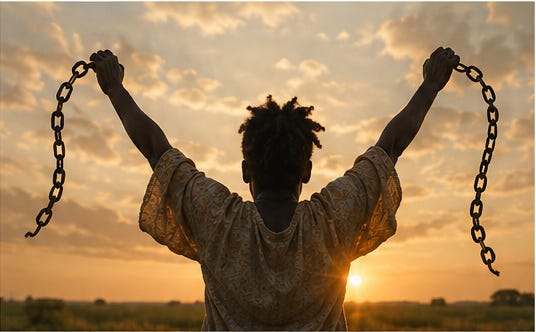
“Freedom is not complete until our bodies, our minds, and our communities are free to live well. Black health is not separate from Black liberation — it is one of the clearest measures of whether this country has honored its promise.”
— Leisha McKinley-Beach, Founder, Black Public Health Academy
On July 4, 1776, the Continental Congress adopted the Declaration of Independence. Its words promised “Life, Liberty and the pursuit of Happiness,” and its ideals have been repeated for 250 years as the foundation of American freedom. But at the moment the nation declared liberty, hundreds of thousands of Black people remained enslaved, bought and sold as property in the same colonies that were celebrating independence.
That contradiction was not accidental. The Library of Congress notes that a paragraph in Thomas Jefferson’s draft condemning slavery and the slave trade was removed by Congress on July 3–4, 1776. In other words, slavery was not merely overlooked in the nation’s founding story; it was negotiated around, edited out, and left alive.
For enslaved Black people, “freedom” was not an abstract political ideal. It was the difference between control and captivity, family and separation, rest and forced labor, care and neglect, life and death. Health itself was shaped by slavery. Enslaved people were denied legal humanity, family protection, bodily safety, and adequate care. Their labor made others wealthy, while their own bodies endured malnutrition, respiratory illness from poor housing, injury from forced work, and high maternal and infant mortality.
Even then, Black people built systems of survival. Enslaved women, healers, midwives, elders, and communities carried knowledge, cared for one another, delivered babies, treated wounds, and preserved life under conditions designed to diminish it. That too is part of the story of freedom: not only resistance in public, but healing in private; not only rebellion against oppression, but care in the face of abandonment.
Nearly a century after the Declaration, Frederick Douglass stood before an audience and asked the question that still echoes across every July Fourth: “What to the Slave Is the Fourth of July?” His 1852 speech exposed the distance between America’s founding language and the lived reality of Black people under slavery. Douglass was not rejecting freedom; he was demanding that America stop celebrating freedom while denying it.

In 2026, Black people are not enslaved by law. We vote, lead, build, teach, heal, create, and serve this country in every field. But freedom cannot be measured only by legal status. It must also be measured by whether people can live long, healthy lives with dignity.
The most recent data available in 2026 still tells a painful story. The Office of Minority Health reports that Black/African Americans had a life expectancy of 74.0 years in 2023, compared with 78.4 years for all races. The CDC reports that in 2024, 20.1% of Black adults were in fair or poor health, and Black infant deaths were 10.98 per 1,000 live births. Hypertension also remains widespread, affecting 56.8% of Black men and 61.0% of Black women age 20 and older in CDC-reported survey data.
The maternal health numbers are especially urgent. In 2024, the maternal mortality rate for Black women was 44.8 deaths per 100,000 live births — significantly higher than the rates for White, Hispanic, and Asian women. KFF also reports that pregnancy-related mortality rates among Black women remain more than three times higher than among White women.
This is not because Black bodies are broken. It is because systems are. Health is shaped by far more than what happens inside a doctor’s office. The Office of Minority Health points to non-medical drivers of health — including income, education, safe housing, healthy food, and reliable health care — as major influences on Black health outcomes. KFF similarly notes that racial health disparities reflect structural and systemic inequities rooted in historical and ongoing racism and discrimination.
The comparison between 1776 and 2026 is not that today is the same as slavery. It is not. But there are throughlines we must be honest enough to name.
Then, Black people’s bodies were treated as labor before they were treated as human. Today, Black patients too often still fight to be believed, heard, protected, and treated with urgency.
Then, health care for enslaved people was often tied to profit, productivity, and control. Today, access to care is still shaped by insurance, income, neighborhood, transportation, hospital closures, environmental exposure, and whether institutions value Black life enough to invest in it.
Then, Black women carried the burden of reproduction under a system that commodified their children. Today, Black mothers and birthing people continue to face preventable risks in a medical system where racism, dismissal, and unequal access can become matters of life and death.
Then, Black communities created healing networks because formal systems failed them. Today, Black doulas, doctors, nurses, therapists, public health workers, faith leaders, mutual aid organizers, and community clinics continue that same sacred work: keeping us alive.
So on this 250th anniversary of American independence, we should ask a deeper question: What is freedom without health?
Freedom is being able to breathe clean air.
Freedom is not being afraid to give birth.
Freedom is having a doctor who listens.
Freedom is safe housing, healthy food, and affordable medicine.
Freedom is a community free of new HIV diagnoses
Freedom is aging with dignity.
Freedom is Black children living past infancy, Black mothers surviving childbirth, Black men receiving preventive care, and Black elders being treated as treasures.
This July Fourth, the fireworks should not drown out the truth. America’s promise was never complete in 1776, and it remains unfinished in 2026. But unfinished does not mean impossible.
To honor freedom, we must fight for Black health as a national priority. That means investing in Black maternal health, expanding access to preventive care, protecting Medicaid and community health programs, training and retaining more Black health professionals, funding mental health care, confronting medical racism, and treating housing, food, income, education, and environment as health issues.
The work of freedom is not only written in the founding documents. It is written in blood pressure readings, birth outcomes, life expectancy, neighborhood clinics, safe parks, full grocery shelves, clean water, and whether a Black patient leaves a hospital feeling cared for instead of dismissed.
After 250 years, America does not need a louder celebration of freedom. It needs a deeper commitment to it.
Because Black health is not a side issue.
Black health is freedom.
Black healing is resistance.
Black thriving is the promise America still owes.