
Walk into a neighborhood pharmacy and you can refill a blood-pressure prescription, receive a vaccination, ask questions about diabetes, pick up contraception, or talk privately with a medication expert.
Increasingly, that same pharmacy may also become a doorway to HIV testing, pre-exposure prophylaxis and other prevention services.
PrEP—short for pre-exposure prophylaxis—is medication for people who do not have HIV that greatly reduces their likelihood of acquiring HIV through sex or injection drug use. It can be taken as a pill or, depending on the individual and provider, received as a long-acting injection. PrEP must be accompanied by appropriate HIV testing, follow-up care, and a conversation about the prevention option that is right for each person.
Expanding PrEP into pharmacies is a significant opportunity for the South. But passing a law and placing medication behind a pharmacy counter do not automatically create access.
People must know the service is available. They must see themselves in the message. They must believe they will be treated with dignity. And they must trust the people providing the service.
That is why Black heterosexual men must be part of this conversation from the beginning.
The men missing from the message
For decades, HIV prevention programs have appropriately invested in populations carrying a disproportionate share of the epidemic, including gay and bisexual men, Black women, transgender people, and people who inject drugs.
Yet Black heterosexual men have rarely been addressed with the same level of focus, visibility, or cultural specificity.
The relative absence of Black heterosexual men is reflected in the broader PrEP evidence base. The Centers for Disease Control and Prevention has described heterosexual adults as underrepresented in PrEP research and public-facing campaigns. In one CDC study of heterosexually active adults in high-HIV-prevalence cities, PrEP awareness was only 32.3%, and reported use was below 1%.
This does not mean every Black heterosexual man needs PrEP. It means every Black heterosexual man deserves accurate information, an opportunity to assess his health needs, and access to prevention without being stereotyped, blamed, or ignored.
Georgia’s surveillance data make the need for a more complete heterosexual prevention strategy especially clear. In 2023, Black women whose HIV diagnoses were attributed to heterosexual contact represented 14% of all new diagnoses in Georgia—the second-largest diagnosis group in the state. Black men whose diagnoses were attributed to heterosexual contact were also among Georgia’s five largest diagnosis groups, accounting for 8%.
Those numbers should change how we think about prevention.
We cannot say that we are protecting Black women while leaving Black heterosexual men outside the prevention conversation. We cannot place the entire responsibility for HIV testing, condom negotiation, PrEP awareness, and relationship health on women. And we should not wait until a man’s partner receives a diagnosis before offering him meaningful prevention information.
Centering Black heterosexual men is not about blaming men. It is about inviting men to share in the knowledge, choices, and responsibility that make relationships and communities healthier.
Louisiana’s broader data add to the urgency. Although Black residents make up about 32% of the state’s population, they accounted for 66% of Louisiana’s new HIV diagnoses in 2024. Men accounted for 72% of the state’s new HIV diagnoses that year. Those data do not tell us the sexual orientation of every man diagnosed, but they do make one point unmistakable: HIV prevention in Louisiana must be designed to reach Black men in all their diversity, including Black heterosexual men.
Georgia and Louisiana are changing what pharmacies can do
Georgia and Louisiana have taken important legislative steps toward making pharmacies part of the HIV-prevention infrastructure.
Louisiana’s Act 711, which took effect August 1, 2024, permits trained pharmacists to prescribe, dispense and administer up to a 30-day supply of PrEP or post-exposure prophylaxis, known as PEP, for people 17 and older under a standing order or protocol developed by the Louisiana Department of Health. The law also permits pharmacists to conduct rapid HIV testing or order laboratory testing under the state protocol. It includes requirements related to training, confidentiality, patient assessment, follow-up and referral to primary care.
Georgia followed with Senate Bill 195, signed into law on May 5, 2026. Under a PrEP or PEP protocol agreement, the law authorizes a pharmacist to issue an order and dispense or administer HIV-prevention medication. Eligible pharmacists may dispense between a 30- and 90-day PrEP supply or administer long-acting injectable PrEP when the law’s testing, documentation and clinical requirements are met. The State Board of Pharmacy is required to approve the pharmacist training program no later than January 1, 2027.
The two state approaches are not identical. Each has its own rules, protocols and implementation timeline. But together, they demonstrate a meaningful Southern policy shift: HIV prevention does not have to remain concentrated in specialty clinics, infectious-disease offices or large medical centers.
It can be offered closer to where people live their everyday lives.
What pharmacies add for Black heterosexual men
For many Black heterosexual men, walking into an HIV-specific clinic may feel disconnected from how they understand their identity, relationships, or health needs. Some men may not believe existing HIV campaigns are speaking to them. Others may avoid services due to stigma, concerns about confidentiality, limited clinic hours, transportation challenges, or prior negative experiences with health care.
A community pharmacy can offer another starting point.
A man can enter a pharmacy without having to publicly identify why he is there. HIV prevention can be discussed alongside blood pressure, diabetes, sexual health, vaccinations, and other routine services. Pharmacists can answer medication questions, review possible interactions, explain adherence, connect patients with financial assistance, and help coordinate laboratory testing and continuing care.
Pharmacies are also widely distributed. The Rx for Change initiative reports that nearly 90% of Americans live within five miles of a pharmacy. Research led by Emory Professor Natalie Crawford suggests that integrating prevention into pharmacies could increase PrEP access points by as much as 80-fold in the southeastern United States.
But proximity alone is not enough.
A pharmacy can be physically close and still feel socially distant. A service can be legally authorized yet remain unknown. A pharmacist can complete clinical training and still be unprepared to communicate with Black heterosexual men in ways that are relevant, respectful, and free of judgment.
That is where community partnership becomes essential.
Building trust in New Orleans
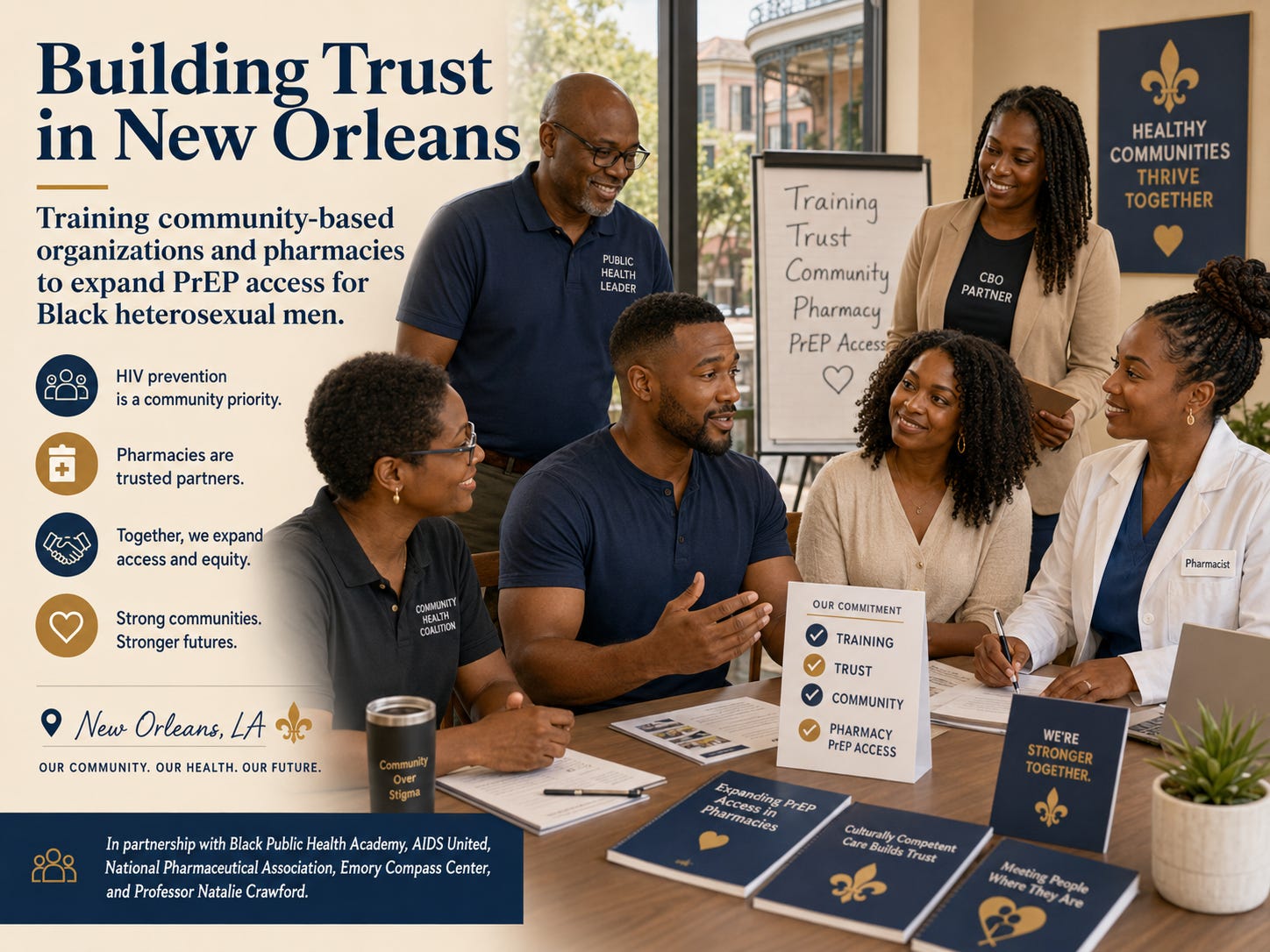
During the week of July 13, 2026, partners are gathering in New Orleans to move pharmacy-based HIV prevention from policy into practice.
The training will prepare two community-based organizations to develop working partnerships with pharmacies. The objective is not simply to place another stack of PrEP brochures near the prescription counter. It is to build a two-way relationship in which pharmacies and community organizations understand one another’s roles, workflows, strengths and responsibilities.
Pharmacy teams need clinical knowledge, but they also need support in communicating with people who may never have considered PrEP. They need to understand how stigma, medical mistrust, financial concerns, relationship dynamics and previous health care experiences can shape a person’s willingness to ask questions.
Community-based organizations need clear information about what each participating pharmacy can provide. Can the pharmacy offer HIV testing? Can it initiate PrEP? What laboratory work is required? Does it provide PEP? How are appointments scheduled? Is there a private consultation space? What happens when a patient needs ongoing medical care? What insurance or medication-assistance navigation is available?
When community organizations understand the pharmacy service model, they can communicate it accurately through the relationships and channels they have already built.
That is what meaningful community marketing looks like.
It is not a generic advertisement telling Black men that they are “at risk.” It is culturally grounded communication that presents HIV prevention as part of health, strength, relationships and planning for the future. It is language developed with the community, not merely translated for the community.
The community organization can introduce the pharmacy as a prevention resource, help men understand what to expect, support referrals and follow up when people experience barriers. Community partners can also provide pharmacies with honest feedback about whether services feel private, welcoming, affordable and respectful.
In other words, community-based organizations are not an accessory to pharmacy implementation. They are part of the infrastructure.
A policy is only as powerful as the trust that carries it into a neighborhood.
Trust is not automatically created by a white coat, a storefront or a new state law. It is earned through confidentiality, consistency, transparency, respectful language and follow-through.
It is earned when a man can ask a question without being judged.
It is earned when costs are explained before services are delivered.
It is earned when the pharmacy has a private space for a sensitive conversation.
It is earned when a person who needs additional care receives a warm connection rather than a phone number on a piece of paper.
And it is earned when the community has a meaningful role in evaluating whether the promised service is actually being delivered.
A partnership built for implementation
This work is being advanced through Rx for Change, a community-centered initiative involving the Black Public Health Academy, AIDS United, the National Pharmaceutical Association and Emory University. The initiative begins with work in Georgia and Louisiana and is designed to connect pharmacies with community-based organizations through training, partnership and local implementation.
Each partner brings a necessary part of the solution.
The Black Public Health Academy brings a Black-led public-health perspective and a commitment to ensuring that policy and implementation are shaped by the communities most affected.
AIDS United brings national HIV leadership, community investment, policy experience and relationships with organizations working across the HIV response.
The National Pharmaceutical Association brings the expertise and lived experience of pharmacists committed to serving Black communities and other historically underserved populations. Pharmacists have long supported people receiving HIV treatment; this initiative expands their ability to play an equally meaningful role in prevention.
Emory contributes two complementary strengths. The Emory COMPASS Coordinating Center has years of experience strengthening Southern community-based and AIDS-service organizations through funding, training, capacity building and technical assistance.
Professor Natalie Crawford, an associate professor at Emory University’s Rollins School of Public Health, brings implementation science and research focused on pharmacy-based HIV prevention and the structural changes needed to reduce racial inequities. Her work has helped demonstrate that pharmacies exist in many neighborhoods where traditional PrEP clinics do not.
The value of this partnership is that it does not treat legislation, research, pharmacy practice and community trust as separate projects. It brings them together.
From legal authority to real access
Georgia and Louisiana have created a legal pathway. Now we must build a community pathway.
That means training pharmacists and the full pharmacy team—not only on medication, testing and clinical protocols, but also on confidentiality, cultural humility and stigma-free communication.
It means ensuring pharmacies are reimbursed adequately for the time and expertise required to provide prevention services.
It means developing private spaces and reliable laboratory arrangements.
It means creating referral systems that do not leave patients to navigate a fragmented health care system alone.
It means equipping community-based organizations with accurate, pharmacy-specific information and the resources to market those services.
And it means designing messages in which Black heterosexual men can recognize themselves.
Success will not be measured only by the number of pharmacists who complete a course or the number of pharmacies that sign a protocol. It will be measured by whether people use the service, return for follow-up, remain engaged in prevention and tell others that they were treated well.
For Black heterosexual men, success may begin with a simple but powerful realization:
This service is for me, too.
Pharmacy-based PrEP is more than a matter of convenience. It is an opportunity to normalize HIV prevention, broaden responsibility for sexual health and bring effective services into the places where people already live, work, shop and care for their families.
Georgia and Louisiana have opened the door.
Our responsibility now is to make sure Black heterosexual men can see that door, trust what is on the other side and walk through it with dignity.