
Juneteenth is not only a holiday. It is a reminder that freedom can be delayed, documented, announced, resisted, and still not fully delivered. It asks a hard question of every generation: when the truth finally reaches us, what will we build with it?
For me, the answer is Black Public Health Academy.
My freedom practice is building Black public health leaders who tell the truth early, protect our people fiercely, and operate in a spirit of excellence even when systems are late, underfunded, or unwilling to see us. This is not abstract. This is my story. This is my contribution to HIV. This is my legacy.
The Florida page that still speaks
I carry Florida HIV history with me. One of the earliest surveillance reports from Florida recorded, through September 1983, 165 AIDS cases and 70 known fatalities - a 42 percent fatality rate. It also noted that Florida ranked third in the number of diagnosed AIDS cases at that time.
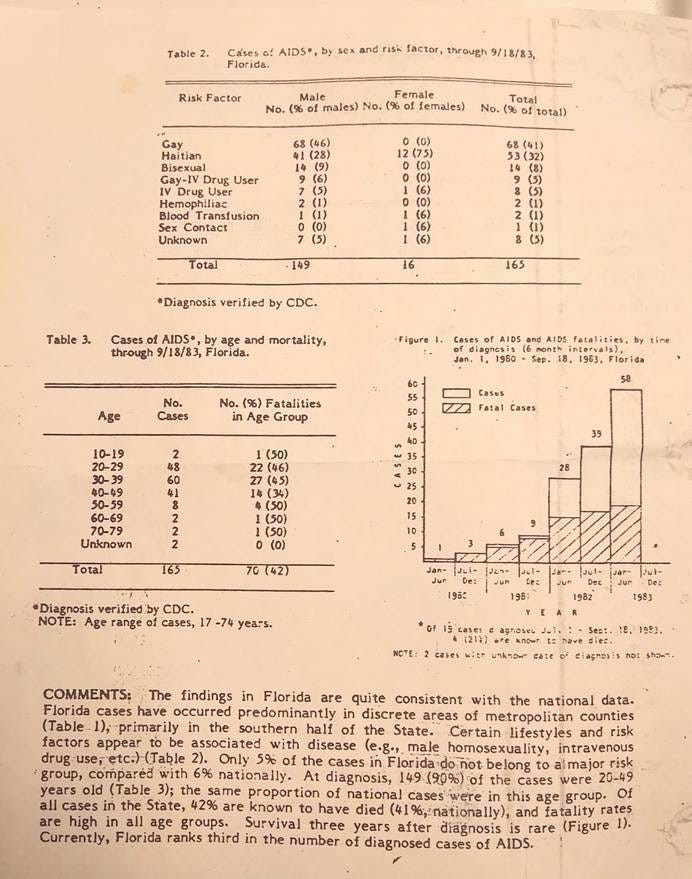
That page is more than an old report. It is a warning. It shows what happens when a new epidemic is counted before it is understood, categorized before people are protected, and allowed to become a public narrative before the communities most affected have the power to shape the response.
The language of those early tables - gay, Haitian, IV drug user, unknown - reflects the surveillance categories of the moment. But every row was a person. Every number was a family, a fear, a funeral, a future interrupted. Black public health leadership matters because we must never let data strip our people of dignity.
The Georgia receipts: HICP before the crisis
That same discipline shaped the work in Georgia. We convened Black public health leaders in Georgia to build a tool that made visible what too many people were not seeing: the added value of people with HIV being supported through the Health Insurance Continuation Program, or HICP, two years before the ADAP crisis forced everyone to confront what happens when medication access is treated as the whole solution.
The point was simple and powerful. ADAP matters. It provides lifesaving HIV medication support. But HICP does something bigger. It helps people keep private health insurance. It can support medication copays, doctor visits, hospital care, mental health services, dental and vision coverage, and continuity of whole-person care. In other words, HICP does not just help people get pills. It helps people stay connected to care.
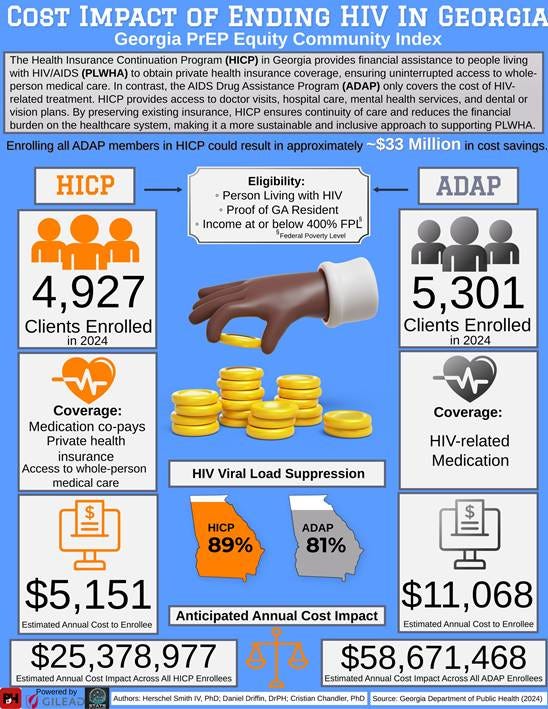
The Georgia tool told a story in numbers: 4,927 HICP clients and 5,301 ADAP clients in 2024; estimated annual cost to enrollee of $5,151 through HICP compared with $11,068 through ADAP; 89 percent viral load suppression among HICP enrollees compared with 81 percent among ADAP enrollees; and an estimated roughly $33 million in cost savings if ADAP members were enrolled in HICP. That is not just an infographic. That is a policy argument, a budget argument, and a moral argument.
And yet, after all of that, someone had to tell me to put my logo on it.
That moment stayed with me. The document was dripping with Black excellence: researchers, community strategy, a CBO, lived knowledge, policy fluency, and love for our people. But I still needed the reminder to publicly claim the work. That is what happens to too many Black leaders. We are trained to save the room, carry the work, produce the proof, and then disappear behind the institution, the grant, the funder, or the urgency of the next crisis.
No more.
Black public health leaders must shine and promote our work - not out of ego, but out of accountability. Visibility is part of the intervention. When our people see who built the tool, who convened the table, who made the data usable, and who stayed when the meeting ended, they see a pathway into leadership for themselves.
Juneteenth and the HIV movement
Juneteenth teaches us that freedom on paper is not the same as freedom in practice. The Emancipation Proclamation had already been signed, but freedom still had to travel to Galveston. Freedom still had to be announced. Freedom still had to be defended.
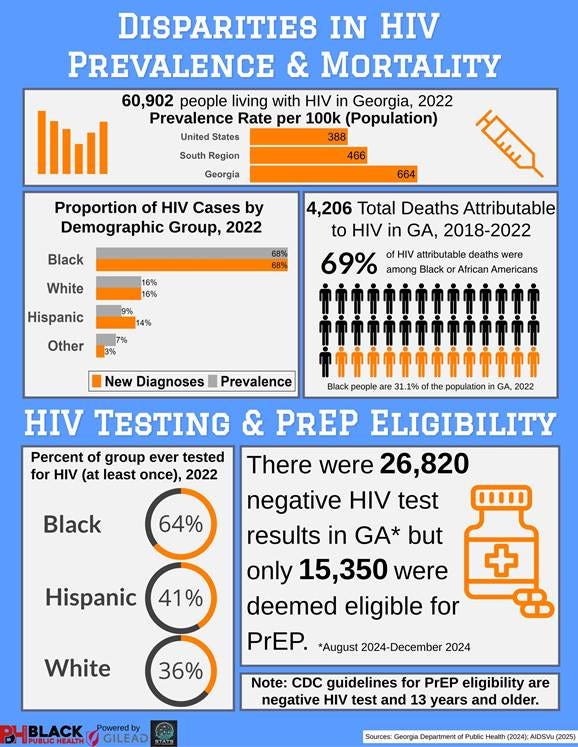
The HIV movement has its own versions of delayed freedom. Delayed testing. Delayed treatment. Delayed PrEP access. Delayed funding. Delayed data. Delayed credit for Black-led solutions. Delayed investment in the very communities carrying the burden.
So on Juneteenth, I am not only celebrating emancipation. I am asking: where is freedom still late in public health?
Freedom is a person with HIV staying insured. Freedom is a Black person receiving care without shame. Freedom is a community-based organization being funded at the level of its value. Freedom is PrEP access before a diagnosis. Freedom is data that moves money where it needs to be, not stigma. Freedom is a Black public health leader putting their logo on the work and saying, clearly: we built this.
Standing on shoulders, not standing alone
I do not arrive at this work alone. I stand on the shoulders of Black advocates and trailblazers who taught us that justice requires voice, strategy, and courage.
I think of Fannie Lou Hamer, whose fight for voting rights reminds us that power is never handed to oppressed people politely. It is organized. It is demanded. It is protected.
I think of Dr. Dawn K. Smith, whose work in HIV prevention and PrEP access modeled what scientific excellence looks like when it is accountable to communities most often left out of the promise of innovation.
I think of Phill Wilson, who helped force the HIV movement to say clearly that Black people needed Black-led HIV strategy - our people, our problem, our solution.
Their legacy gives me language for my own: build leaders, protect the people, and never separate excellence from love.
From surveillance to saving ourselves
That is why 45 Minutes to Saving Ourselves matters to me. It is not just a town hall. It is a bridge from history to action.
From Winter Haven to Gainesville, Jacksonville to Tallahassee, Eatonville to Fort Lauderdale, the message is consistent: our community, our voices, our solutions, our power. The work is not coming from outside to rescue us. We are building inside-out strategies to connect people to HIV services, keep people in care, and end new diagnoses in Black communities.
The pledge says it plainly: We show up. We stay committed. We keep our people in care. We save ourselves.
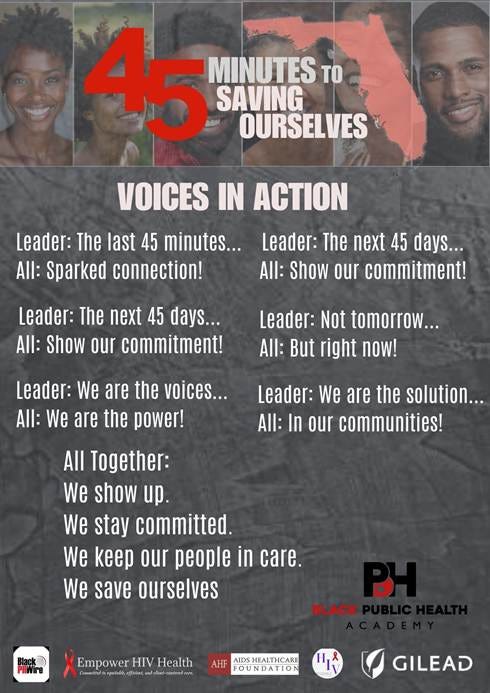
That is not a slogan. That is a public health model.
A Juneteenth charge to Black public health leaders
This Juneteenth, I want every Black public health leader to hear this: do not hide the receipts.
Put your name on the work. Put your logo on the work. Cite Black researchers. Fund Black CBOs. Mentor the next leader. Build tools our people can understand. Translate data into action. Refuse to let policy conversations erase the communities that made the solution possible.
We do not need leadership that only performs proximity to power. We need leadership that is true to our people. Leadership that can sit at the table without becoming owned by the table. Leadership that knows the numbers and knows the names. Leadership that operates in excellence because our communities deserve nothing less.
My legacy will not only be the programs I helped build or the documents I helped produce. My legacy will be Black Public Health Leaders who know their worth, their history, their data, and their responsibility to our people.
That is how I celebrate freedom this Juneteenth.
I shine because my people deserve to see the light. I promote the work because it can save lives. I claim the contribution because invisibility has never protected Black people. And I build because freedom is not finished until our communities are alive, cared for, resourced, and leading.