
Reporting note: This article reflects information available as of July 20, 2026. Details concerning the July 14 supplemental guidance were circulated to affected organizations, and additional federal implementation guidance may follow.
Culture is not the music playing at an outreach event. It is not the photograph selected for a prevention campaign or the language added to a grant proposal.
Culture is whether the person offering an HIV test understands the community they are serving. It is whether a young Black gay man sees someone he trusts when he walks through the door. It is whether a Black woman feels safe discussing PrEP without being judged. It is whether a transgender person believes their name, body, privacy, and life will be respected.
In HIV prevention, culture is not an accessory to the intervention.
Culture is the intervention.
That is why the decision not to recompete the Centers for Disease Control and Prevention’s Comprehensive High-Impact HIV Prevention Programs for Community-Based Organizations—known as PS21-2102—must be treated with the urgency it deserves.
Let me begin with two truths.
First, this decision can cause great harm to Black-led and Black-serving organizations, their workforces, and the communities that depend on them.
Second, our organizations and communities are not powerless. We have overcome funding cliffs, policy reversals, stigma, medical mistrust, and systems that were never designed with us in mind.
We can overcome this moment, too.
But overcoming it cannot mean quietly expecting Black organizations to do more with less while the decision-making power and funding move farther away from the community.
What is changing
PS21-2102 was the CDC cooperative agreement that directly funded a national network of community-based organizations to deliver HIV testing, linkage to medical care, referrals for PrEP and PEP, navigation, prevention education, and outbreak response.
CDC previously described 96 directly funded CBOs as uniquely positioned to reach people who could benefit most from HIV prevention, including communities of color, LGBTQ+ people, transgender people, and people who use drugs. The archived recipient list includes organizations across the country, from large health systems to deeply rooted neighborhood organizations.
That list is not an abstraction. It includes Black-serving and Black-led organizations such as Abounding Prosperity in Dallas, NAESM in Atlanta, and PALSS in South Carolina—organizations whose programming is intentionally built around the lives, cultures, and health needs of Black communities.
Organizations have now been informed that the Office of Management and Budget directed CDC not to recompete PS21-2102 as a dedicated, direct funding opportunity for CBOs. AIDS United publicly confirmed the non-recompetition decision on July 17 and warned that it could reduce testing, interrupt access to PrEP, PEP, and care, eliminate frontline positions, and force some community programs to reduce services or close.
According to the July 14 update circulated to affected organizations, CDC will instead provide noncompetitive supplemental funding through health departments already funded under PS24-0047, the High-Impact HIV Prevention and Surveillance Programs for Health Departments. The reported supplement equals 25% of each health department’s current-year award and is intended to support expanded HIV testing, surveillance improvements, and PrEP and PEP activities from June 1, 2026, through May 31, 2027.
Public HHS award records also show that at least some current PS21-2102 grantees received late-June administrative supplements equal to roughly one-quarter of a prior annual award, with individual award periods extended through September 30, 2026. That short runway matters. But it should not be mistaken for a new five-year direct CBO funding program.
A dollar routed to a health department is not yet a dollar in the community
I want to be clear: health departments are essential partners in HIV prevention. This is not an argument against health departments.
It is an argument for understanding the difference between direct funding and the possibility of receiving a future subaward or contract.
Under direct CDC funding, a CBO has its own relationship with the federal agency, an approved budget, defined program authority, and greater ability to plan its workforce and services over multiple years.
When that money is routed through a state or local health department, the CBO is no longer guaranteed to receive it.
The health department must decide which organizations will be funded, how much they will receive, which activities will be supported, what procurement process will be used, when contracts will begin, what indirect costs will be allowed, and how quickly organizations will be reimbursed.
Even when everyone involved has good intentions, a funding transition can create months of delay. A trusted organization may have to lay off the navigator who knows every client by name before a new contract is executed. A mobile testing program may stop operating while a procurement process moves forward. A small, Black-led organization may be placed in competition with a hospital system that has an entire grants and contracting department.
The greatest danger is not only that fewer HIV tests will be administered.
The danger is losing the relationships that make people willing to take the test.
Black communities cannot afford another layer of distance
In 2024, Black people represented approximately 12% of the United States population but accounted for 39% of HIV diagnoses. The South accounted for 51% of all diagnoses. Black women represented 52% of diagnoses among women, despite representing approximately 13% of the female population.
These disparities are not the result of something culturally wrong with Black people. They reflect the consequences of structural racism, unequal access to health care, poverty, unstable housing, stigma, criminalization, medical mistrust, transportation barriers, and years of insufficient investment in the institutions closest to our communities.
Black-led and Black-serving organizations do more than deliver a service.
They translate public health into language that people can use. They know which outreach strategy will work in a particular neighborhood. They know when a person needs transportation, food, housing assistance, mental health care, or simply more time before they are ready to discuss prevention. They understand that someone’s ability to remain on PrEP or stay connected to HIV care may depend on far more than a prescription.
The results support what communities have long known. An analysis of CDC-funded programs from 2019 through 2021 found that CBOs linked 86.7% of people newly diagnosed with HIV to medical care within 30 days, compared with 73.7% in the health department program. People served through the CBO program were also connected to care more quickly.
That does not mean health departments cannot achieve strong outcomes. It means CBOs provide a distinct and measurable form of public health infrastructure that should not be treated as interchangeable or optional.
Black leadership is not branding
There is another issue we must name.
A Black-serving program is important. A Black-led organization also carries decision-making power, ownership, institutional memory, workforce development, and economic impact within the Black community.
When funding moves away from Black-led organizations, those organizations may still be invited to conduct outreach, recruit participants, provide cultural advice, sit on committees, and lend credibility to a larger institution’s proposal. But the larger institution may control the money, data, employment, and program design.
That is not equity.
That is, extracting community knowledge without adequately funding community power.
The federal shift is occurring in a philanthropic environment where Black-led nonprofits are already less likely to receive sustained foundation support. A 2026 Candid and ABFE analysis found that, in an average year, only 50% of Black-led nonprofits received a foundation grant, compared with 70% of other nonprofits. Among small Black-led organizations, only about 30% received a foundation grant in a given year.
Telling these organizations to “diversify their funding” is not enough. Funders, hospitals, corporations, health plans, and government agencies must also change the practices that have repeatedly locked Black organizations out of long-term capital.
Still, organizations need immediate strategies. Advocacy to restore direct federal funding must continue, but payroll, rent, insurance, testing supplies, and client needs will not wait for the policy process.
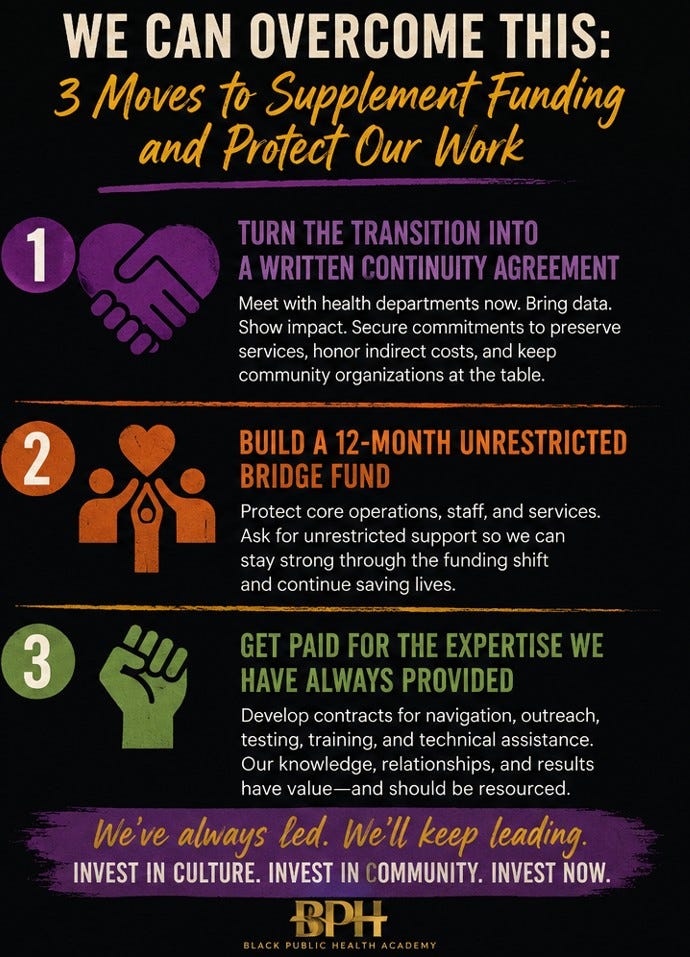
Three things organizations can do now to supplement funding
1. Turn the health department transition into a written continuity agreement
Do not wait for a general request for proposals to appear.
Request a meeting now with the state or local health department receiving PS24-0047 funds. Ask for the person responsible for the supplemental award, procurement, contracting, and program implementation to be in the same conversation.
Bring a concise continuity packet that documents:
The number of people currently receiving testing, navigation, PrEP or PEP referrals, and linkage services.
The neighborhoods and priority communities your organization reaches.
Your outcomes, including linkage rates and time to care.
The staff positions and service sites at risk.
The monthly amount required to prevent layoffs or service interruption.
A proposed scope of work and budget that the health department can quickly adapt into a subaward.
The immediate ask should be specific: preserve the existing service network through the fastest lawful contracting mechanism; avoid unnecessary recompeting of proven services; honor allowable indirect costs; use monthly rather than delayed quarterly reimbursement; and provide startup or advance funding where permitted.
The existing PS24-0047 framework already emphasizes community engagement, health equity, local partnerships, and culturally responsive implementation. It allows health departments to support grassroots organizations, including through microgrants. Organizations should use that language to insist that community partnership be funded—not merely discussed.
Where several PS21-2102 organizations operate in the same jurisdiction, approach the health department together. A shared continuity proposal is harder to dismiss than a series of isolated requests.
2. Build a 12-month unrestricted bridge fund—not 12 new restricted projects
The immediate financial goal should be to protect core operations while public funding is being reorganized.
Create a 12-month bridge budget that identifies exactly what is needed to retain essential staff, maintain testing and navigation, keep service locations open, and sustain financial and data systems.
Then take one coordinated request to local and national foundations, hospital community-benefit programs, health plans, corporations, pharmaceutical philanthropy, faith communities, major donors, and city or county leaders.
Ask for unrestricted general operating support.
This is not the time for organizations to chase multiple small grants that each require a new pilot program, separate reporting system, and different set of outcomes. Restricted grants can create activity while still leaving an organization unable to pay its finance staff, insurance premium, technology costs, or rent.
Make the funding request easy to understand:
$25,000 protects a peer navigator or outreach position.
$50,000 sustains mobile testing and community engagement.
$100,000 prevents a service site from closing during the transition.
Organizations in the same region can also create a pooled community HIV prevention fund, use one fiscal intermediary, or share a development consultant. Collaboration should reduce administrative burden—not force culturally distinct organizations to surrender their identities or leadership.
3. Require systems to pay for the expertise they have historically received for free
This is not my favorite action but may be necessary for the survival of our organizations. Black-led and Black-serving organizations possess valuable expertise in community engagement, culturally responsive communication, peer navigation, stigma reduction, Black LGBTQ+ health, faith engagement, recruitment, retention, and outbreak response.
That knowledge should become a source of recurring, mission-aligned revenue.
Organizations can develop contracts with hospitals, federally qualified health centers, health plans, universities, local governments, research institutions, and larger nonprofits for services such as:
Community health worker and peer-navigation programs.
HIV and STI testing events.
PrEP and PEP navigation.
Cultural-responsiveness training.
Community advisory-board design and facilitation.
Recruitment and retention for health programs or research.
Evaluation of whether campaigns and services are reaching Black communities.
Technical assistance for organizations seeking to improve Black LGBTQ+ engagement.
Where state laws, clinical arrangements, and payer rules allow, organizations should also explore reimbursement for eligible navigation, testing, behavioral health, and community health worker services.
This is not about commercializing culture. It is about refusing to let institutions use Black relationships, credibility, labor, and knowledge without paying their full value.
Supplementing funding is not surrendering the fight
These three strategies can help organizations survive and adapt. They are not substitutes for dedicated public investment.
The administration should reverse the decision and preserve a direct, competitive CBO funding mechanism. Congress should use appropriations and oversight authority to make clear that federal HIV prevention dollars must continue reaching community-based organizations directly. Health departments should publicly commit to maintaining the current CBO infrastructure and preventing interruptions in testing, PrEP, PEP, and linkage services.
Philanthropy must respond with rapid, unrestricted funding—not another year of listening sessions.
Hospitals and health plans that benefit when people are diagnosed earlier and remain healthy should invest in the community infrastructure producing those outcomes.
And individual supporters should use the archived PS21-2102 recipient list to find an organization in their state and make an unrestricted contribution now.
We can overcome this—but we should not have to overcome it alone
Black communities were doing HIV prevention before many institutions learned how to speak respectfully about HIV.
We created organizations, support groups, ministries, houses, chosen families, outreach teams, care networks, and spaces of healing. We turned grief into strategy and stigma into service. We learned how to reach people whom larger systems had ignored, blamed, or abandoned.
That history gives me confidence that we can overcome this moment.
But resilience is not permission to disinvest.
We should not celebrate Black organizations for surviving preventable harm. We should fund them so they can lead, innovate, employ people from their communities, and continue delivering the culturally grounded prevention that the country says it values.
This decision is a major blow.
It is not the end of the work.
But what happens next will depend on whether health departments, lawmakers, philanthropy, health systems, and the public recognize one essential truth:
You cannot end the HIV epidemic while defunding the culture, leadership, and trust that make HIV prevention possible.
Thank you for your tireless leadership!