
I didn’t attend AIDS 2026 in Rio but followed the posts, emails, and blogs of HIV advocates who did. From what I saw, it gave the HIV movement two very different maps.
The first was the now-infamous map of Africa presented during a U.S. State Department session at AIDS 2026. Every country highlighted on the map was incorrectly located. The State Department apologized, but the damage had already been done. The error became one of the most widely discussed stories from the conference.
The second map was far more important. It was the map of where the HIV response is headed, and where it could collapse.
In his reflection on AIDS 2026, Jirair Ratevosian challenged us to look beyond the State Department’s mistake and focus on what the conference revealed about prevention, access, community leadership, financing and the future of the HIV response. His point was not that the bad map did not matter. His point was that we cannot allow one embarrassing image to distract us from the much larger question: Do we have the leadership, systems and unity required to finally erase HIV from the map? (Ratevosian)
For Black leaders in HIV, that question carries a special urgency.
We know what it feels like to be visible in the data but missing from the decisions. We know what it means to be called upon to recruit, educate, test, link, navigate and repair trust, while other institutions control the resources and determine the strategy. We know what happens when Black communities are placed on someone else’s map but are not allowed to help draw it.
The map presented in Rio was wrong.
But the more dangerous mistake would be continuing to build an HIV response that gets the location of Black leadership wrong.
The Paradox We Must Carry Home From Rio
The theme of AIDS 2026 was “Rethink. Rebuild. Rise.”
That theme could not have been more appropriate. The International AIDS Society described a conference taking place against a backdrop of major scientific progress and extraordinary political and financial disruption. More than 1,700 clinics and other service-delivery sites have reportedly closed because of changes in U.S. funding and policy. Donor-government funding for HIV fell by 25%, while community organizations and health workers were being asked to protect decades of progress with fewer resources. (International AIDS Society)
At the same time, the science presented in Rio was remarkable.
Long-acting HIV prevention is moving from possibility to implementation. Ninety-five percent of participants across the PURPOSE 1 and PURPOSE 2 studies chose to continue twice-yearly injectable lenacapavir. Once-monthly oral prevention, longer-acting injections and once-weekly HIV treatment could create more choices for people whose lives, bodies and preferences do not fit a one-size-fits-all approach. (International AIDS Society)
But the conference delivered an unmistakable warning: scientific choice is not the same as community access.
Pricing will influence whether governments and health systems can offer new options. Clinics and pharmacies will need trained providers. Supply chains will have to manage multiple products. Insurance systems and public programs will need to cover them. Community organizations must be funded to educate people, address misinformation, support decision-making and help individuals remain engaged.
A medicine may be approved. A shipment may arrive. A press release may announce a breakthrough. None of those things guarantees that a Black woman in rural Georgia, a Black gay man in Mississippi, a Black transgender woman in Florida or a Black heterosexual man in Louisiana will be offered that option.
Access will depend on whether trusted Black-led organizations are involved early enough to shape implementation—not brought in later to repair it. As the SciDev.Net coverage from Rio emphasized, affordability, financing, regulatory approval, provider capacity, integration and community voice will ultimately determine whether scientific advances become real choices. (SciDev.Net)
The Bridge From Rio to Anaheim Is Black Leadership
On September 17–20, the HIV movement will gather in Anaheim, California, for the United States Conference on HIV/AIDS. The 2026 USCHA theme is “United and Unbreakable: The HIV Movement at 45.”
USCHA also marks 30 years since the conference began as NMAC’s National Skills Building Conference. Its history is rooted in community—people living with HIV, frontline workers, advocates and organizations creating a space built by and for the movement. This year’s program is intentionally focused on community power, storytelling, access, organizational capacity, emerging science, and the infrastructure needed to sustain the response. (NMAC)
The themes of the two conferences belong together.
Rethink who gets to define the problem.
Rebuild the organizations and systems that communities depend upon.
Rise with the people most affected leading the way.
Then arrive at USCHA united and unbreakable.
The bridge between Rio and Anaheim cannot be another report, webinar or conference recap. The bridge must be Black leadership moving with greater alignment, discipline and collective power.
Black communities have never lacked ideas, trusted leaders or commitment. What we have often lacked is coordinated investment in the infrastructure required to carry our ideas from one conference to the next—and from the conference stage into our communities.
Research highlighted through NATAP at AIDS 2026 also called attention to stigma-related challenges faced by people living with HIV and gaps in the responses of patient advocacy organizations. The implication is clear: new medicines will not automatically eliminate stigma, misinformation, fear or medical mistrust. Organizations need trained people, effective communications, trusted messengers and the capacity to respond consistently. (NATAP)
This is why Black leadership is not an optional cultural addition to the HIV response.
Black leadership is part of the delivery system.
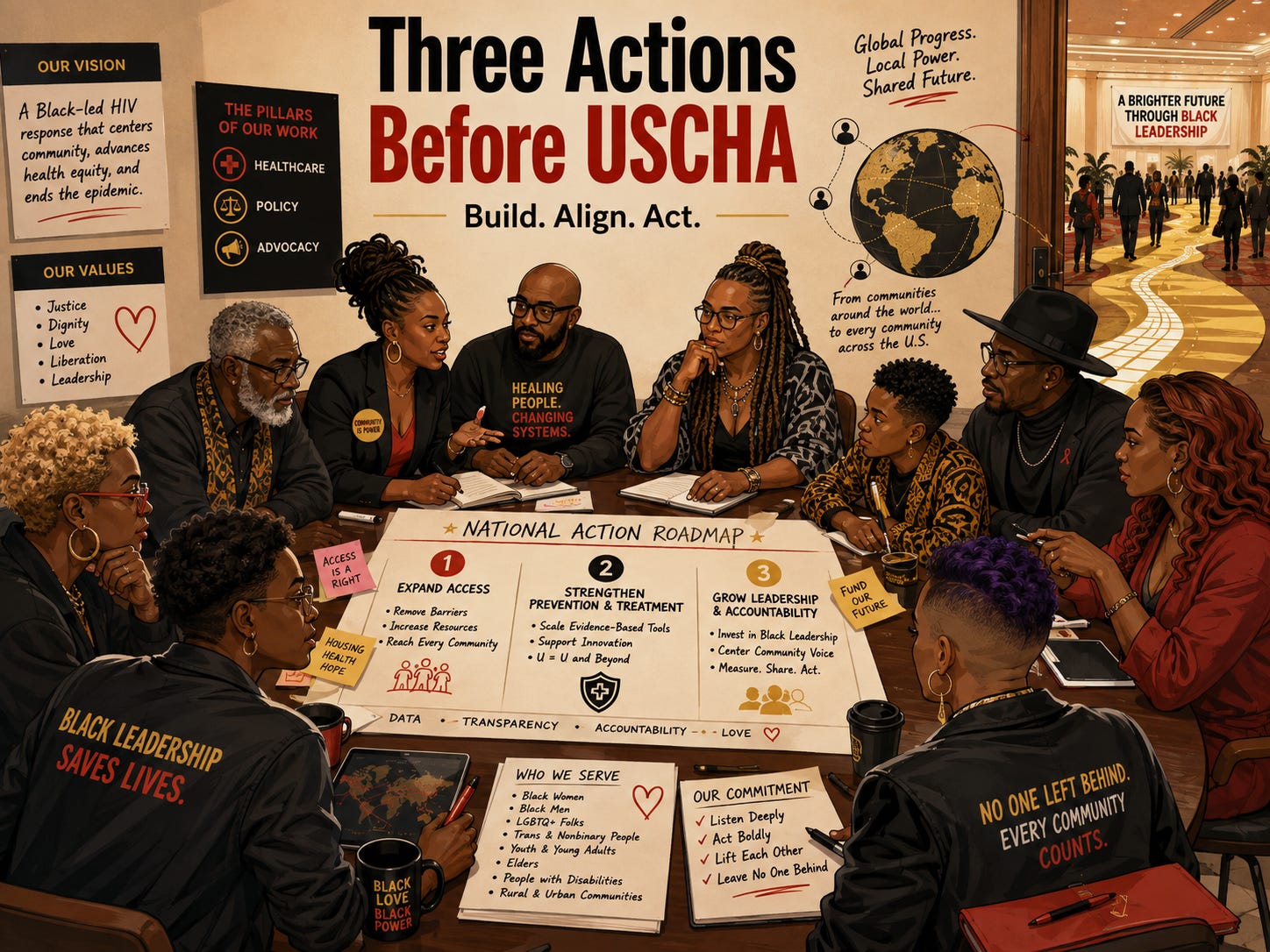
Three Actions Before USCHA
1. Establish a Black HIV Leadership Compact
Before arriving in Anaheim, Black HIV leaders should convene across organizations, identities, generations and geography to establish a short, written Black HIV Leadership Compact.
Black people living with HIV must be at the center. The table must also include Black women, Black LGBTQ+ leaders, transgender and nonbinary people, Black heterosexual men, young people, elders, researchers, clinicians, faith leaders, rural leaders, Southern leaders and Black-led community organizations.
The compact should establish at least three shared commitments:
Sustainable investment in Black-led HIV infrastructure
Affordable and timely access to prevention and treatment choices
Meaningful Black decision-making power in research, policy, funding and implementation
Unity does not require every organization to become the same or agree on every issue. Unity means that our differences will not prevent us from defending a common agenda.
By September 1, Black leaders should be able to carry one clearly stated set of priorities into USCHA. We should not enter every government meeting, funder conversation, and pharmaceutical session with unrelated demands. We can maintain our individual missions while speaking collectively about what our communities require.
2. Build a Black Access and Readiness Map
Rio taught us that the next HIV challenge is not simply discovering more products. It is building systems capable of delivering choice.
Before USCHA, Black-led organizations should assess what it would take to deliver current and emerging prevention and treatment options in their communities. That assessment should examine:
Provider and pharmacy readiness
Insurance, Medicaid, Medicare and ADAP coverage
Laboratory and referral capacity
Transportation and appointment barriers
Privacy, stigma and community awareness
Workforce training and compensation
Supply-chain and medication availability
Community education and navigation needs
This should become our own map—a map built from the lived realities of Black communities.
The State Department’s map failed because it did not accurately locate the people and countries it claimed to represent. Our access map must do the opposite. It must identify exactly where systems are failing, where trusted organizations are operating, what resources are missing and who must be accountable for closing each gap.
We should arrive at USCHA with evidence, not simply frustration. We should be able to say: “Here is what the science promises. Here is what Black communities currently have. Here is the distance between the two. Here is what it will cost to close that distance.”-- Leisha McKinley-Beach
3. Organize One Narrative and a 90-Day Accountability Plan
Black leaders must become more intentional about who tells our story.
Before USCHA, we should develop shared messages, identify and prepare Black spokespeople, engage Black media, and create clear questions for federal agencies, health departments, funders, researchers, and pharmaceutical companies.
Our message should be consistent:
“A breakthrough that does not reach Black communities is not a public health victory.”-- Leisha McKinley-Beach
At USCHA, we should ask the same accountability questions across sessions:
Who was involved in designing this program?
How many Black-led organizations are funded to implement it?
How will people without insurance obtain access?
What data will show whether Black communities are benefiting?
Who is accountable if access falls short?
Most importantly, USCHA must end with a 90-day action plan. Each commitment should have an owner, deadline and public measure of progress. A post-USCHA Black HIV leadership scorecard could track funding decisions, access commitments, organizational partnerships, media representation and progress toward shared priorities.
What Black Leaders Should Walk Away With
Black leaders should leave USCHA with more than photographs, business cards, presentation notes and invitations to future meetings.
We should leave with a shared agenda.
We should leave with named partners.
We should leave with a national network connected to local implementation.
We should leave with concrete funding requests and clearly defined technical-assistance needs.
We should leave with a 90-day work plan and a public accountability process.
We should also leave with an intergenerational leadership strategy. Forty-five years into the HIV movement, our responsibility is not only to honor the leaders who carried us here. It is to ensure that younger Black leaders inherit relationships, knowledge, resources and real authority—not merely ceremonial seats at the table.
USCHA should remind us that Black leadership is not scarce. Black organizations are not without solutions. Black communities are not waiting to be saved.
What is needed now is greater alignment.
Greater investment.
Greater protection of our institutions.
And a deeper commitment to one another.
We Are the Infrastructure
“United and Unbreakable” cannot be only a conference theme.
It must become a leadership standard.
To rethink means recognizing that Black communities are not simply populations to be reached. We are experts, decision-makers and architects of the response.
To rebuild means investing in Black-led organizations, communications systems, workforce development, community research, policy capacity and sustainable leadership.
To rise means refusing to let scarcity turn Black leaders against one another while the institutions controlling the resources remain protected.
And to be unbreakable means that when one organization is threatened, one community loses services or one leader is pushed out of a decision-making space, the rest of us do not remain silent.
By the time we reach Anaheim, the question should not be whether Black leaders were invited.
The question should be:
What did Black leaders organize?
What did we demand together?
What did we commit to protect?
And what infrastructure did we build so that our collective power lasts beyond the conference?
We are the memory of this movement.
We are the trust that makes services possible.
We are the messengers who can turn science into understanding.
We are the leaders who know where the gaps are because we live and work inside them.
We are the infrastructure.
From Rio to Anaheim, let us move as one—Black, united and unbreakable.